Originally published by The Tablet.
The Church of England is taking its time to find a new leader – and there is every chance the hunt could end in deadlock
When Pope Francis died in April leaving the Catholic Church leaderless, it entered a state the Church of England had already been languishing in for almost five months. And yet just 17 days later, the senior cardinal deacon appeared on the loggia of St Peter’s to announce, Habemus papam. Meanwhile, the earliest a new Archbishop of Canterbury will be announced is September, and already that elongated timeline is under threat of being nudged backwards.
How can it be that the Anglicans need 10 long months to accomplish what took the Catholics barely a fortnight? Is this really the best way of finding a new archbishop? Before Francis’ death, tongues were already wagging about the foot-dragging of the Church of England, and the speedy turnaround in Rome has only sharpened that critique. Some are even suggesting the C of E abandon its drawn-out efforts to replace Justin Welby, given they’ve got by fine without an Archbishop of Canterbury for the past half year already.
But the archbishop is not simply the head of the C of E; they’re also the spiritual leader of the global Anglican Communion, a network of more than 40 denominations affiliated to the C of E which has been splintering over deep internal divisions on sexuality and gay marriage in recent decades. And the archbishop is also, still, a significant figure in British civic life – part of the Privy Council and next in precedence and rank after the royals at state occasions. It’s likely Welby’s successor will one day crown Prince William as King. The C of E may be trundling along OK during its interregnum, but at some point we will need to settle on who should be the 106th occupant of Canterbury’s cathedra.
The way it is supposed to work is that a special committee, the Crown Nominations Commission (CNC), is assembled to shortlist, interview and then appoint the successor to Welby. Even then, there are more hoops: because the C of E is the established state Church, the name the CNC lands on has to be first passed on to the prime minister, who then recommends to the King that he formally appoint him or her.
Welby announced his resignation in November and formally laid down his crozier in early January, but the Canterbury CNC did not hold its first meeting until late May. It’s scheduled to meet again in July and again in September – before finally choosing a name.
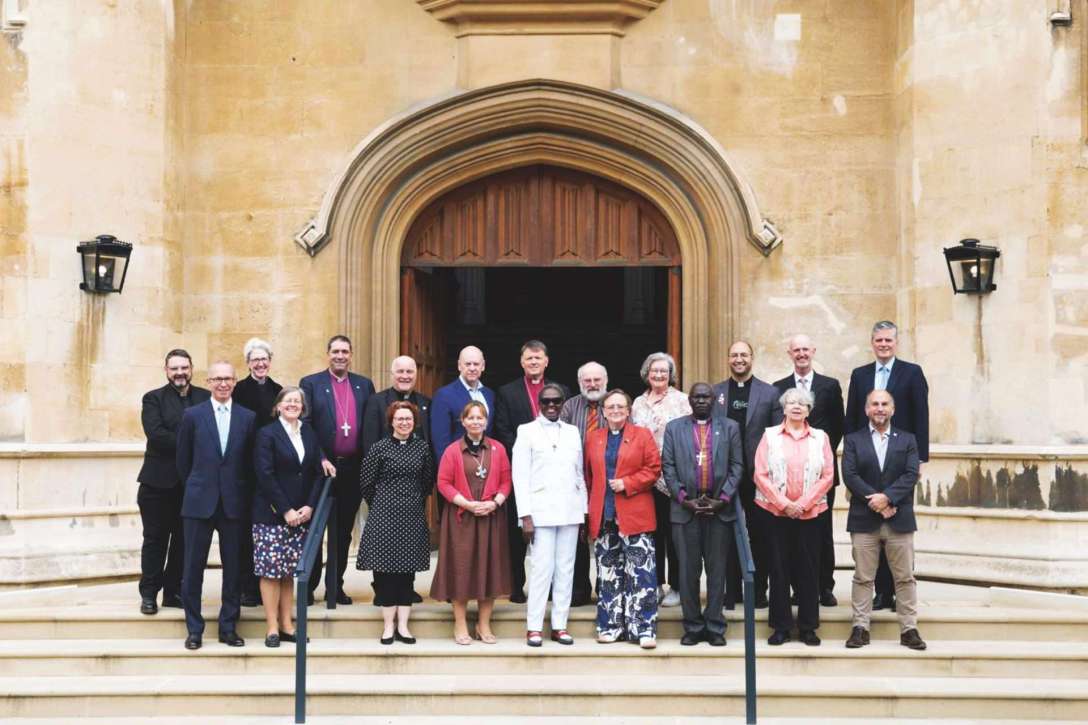
When it comes to appointing a new Archbishop of Canterbury, the CNC is made up of 17 voting members. The chair must be a lay churchgoing Anglican – this time it will be the former head of MI5 Jonathan Evans, now an independent member of the House of Lords. Then there is the second most senior figure in the C of E, the Archbishop of York, Stephen Cottrell, plus one other bishop elected by their colleagues (this time it is the Bishop of Norwich, Graham Usher).
There are also five people chosen to represent other Anglican Churches from around the world. These are a mixture of archbishops, bishops, vicars and lay people from Europe, Africa, Asia, Oceania and the Americas. There are also six members of the General Synod, the C of E’s elected parliament. These people were elected at the start of the synod’s term in 2021 – long before publication in 2024 of Keith Makin’s report on the John Smyth abuse scandal, which consumed Welby – so it should have been straightforward to include them on the CNC. However, one of them, Andrew Cornes, is a retired vicar who was himself implicated in Makin’s report, and has been forced to step back while the Church investigates further. A replacement had to be found at the last minute.
Finally, there are three people sent from the Diocese of Canterbury to represent local concerns. It was choosing this final group which gummed up the process. The Canterbury three were supposed to be chosen from yet another committee, but shortly after the process got under way, someone in the diocese stumbled across an awkward truth. Long before anyone thought this obscure panel would have the eyes of the world upon it, the members had been illegitimately selected due to a misunderstanding about the election rules – so it had to be junked and the election re-run.
Already at risk of descending into farce, the Canterbury diocese then made another series of administrative cock-ups. They eventually admitted in May that the entire thing would have to be run a third time, pushing back finalising the CNC membership again.
As the diocese stubbornly refused to explain any of the problems with this now cursed and chaotic committee, conspiracy theories flourished in the vacuum. Why were these elections being run and re-run over and over, conservative Anglicans began to ask? Were liberal church officials trying to fiddle with the results to get their preferred progressive candidates on the slate? In one now infamous example, an evangelical vicar with 10 votes lost her seat to a liberal with just one. Although this was eventually explained by the torturously complex rules to ensure fair representation between lay people across the diocese, it looked like the blatant disenfranchisement of conservatives. Is the CNC being rigged by progressives to ensure it produces their preferred kind of archbishop?
All of this came at a time when the bishop-appointing procedure in the C of E was already under scrutiny. On several occasions in recent years, CNCs convened to fill vacancies have collapsed after the members failed to coalesce around any candidate with the necessary supermajority – under the rules, at least two thirds of the members of the full CNC, including abstentions, must support a nomination before it can go forward to the King. This has left a number of dioceses leaderless for a year or more as the process begins from scratch. But it’s also further inflamed the already bitter civil war dividing the Church over gay blessings.
Although the CNC deliberations are supposed to be confidential, it is widely assumed that conservatives opposed to the Prayers of Love and Faith (PLF) – as the liturgical resources developed by the Church of England for use in same-sex blessings are known – are vetoing candidates they deem insufficiently orthodox. This has infuriated the majority in favour of permitting the blessing of gay relationships, and led to the hierarchy proposing tweaks (including giving the Archbishop of York the casting vote) to prevent deadlocks. However, these reforms were tossed out by a rebellious meeting of the synod in February.
There is every chance the same tribal divisions will cripple the deliberations of the Canterbury CNC. We know that at least three of the six synod reps on the CNC are determined opponents of the PLF, and it’s far from impossible that with others they could stymie any attempt to appoint a pro-PLF figure to replace Welby. But without a two-thirds majority for the evangelicals’ own candidate, the committee could, once again, be deadlocked.
The wild card element is the five international reps from the Anglican Communion. They’ve been far removed from the furious bickering over gay blessings and nobody really knows how they will fit into the well-worn grooves of the C of E’s factional infighting. Also in the room will be two mandarins, Stephen Knott and Jonathan Hellewell, the Church and the prime minister’s respective appointments secretaries. But while they both keep a low profile and don’t have a vote, their role is pivotal in suggesting candidates for the CNC to consider (and, cynics argue, subtly steering members away from those the hierarchy is less keen on).
Assuming the CNC will eventually find its preferred candidate, which names are in the frame? Looking back at all the archbishops appointed since the Second World War, the Church has a clear preference for men (it has only ever been men before, though this time it could be a woman) who are not too old, which in Anglican bishop terms means 60ish or younger, given the mandatory retirement age of 70. They have also preferred someone who has decent experience leading a diocese – with the exception of Welby, who was made a bishop only one year before becoming archbishop.
The famous Catholic tradition of “thin pope, fat pope” is also at play. Since the war, the C of E has alternated between evangelicals and more High Church sacramental types, between conservatives and liberals. Given that Welby was a moderate charismatic evangelical, many observers believe his successor is likely to be a more liberal-minded Anglo-Catholic figure. It’s also hard to imagine someone not in favour of the PLF getting the nod, given the blood, sweat and tears invested by the Church hierarchy so far in the gay blessings project.
Once you whittle away those who are too old, too inexperienced and too evangelical, there are relatively few names left in the hat. Many people’s favourite would be Guli Francis-Dehqani, the Bishop of Chelmsford. A child refugee from Iran who fled Islamist persecution, she has a compelling personal story and has impressively led the C of E’s work around migration and housing. She’s also pro-PLF and has quietly signalled her preference for investing in traditional parish ministry rather than the whizzy evangelical church plants favoured by Welby. Other names suggested include Michael Beasley, the Bishop of Bath and Wells, who has forged a curious middle-ground. He’s in principle in favour of blessing gay couples but has spoken out against the way the bishops are trying to ram their plans through the synod. Another one to look out for would be Sarah Mullally, the Bishop of London. Previously the chief nursing officer in the NHS before taking the cloth, Mullally is capable, has deep leadership experience and is vocally pro-PLF. Her age and what some regard as her turgid personal style may count against her, however.
But, whoever eventually emerges, is the whole appointment process a bit of a joke, given its plodding timetable and byzantine procedures? In theory, the CNC is intended to give a voice to all the different groups the new archbishop will end up leading, from their local diocese in Canterbury, to the House of Bishops, the synod and ultimately the global Anglican Communion. And the two-thirds supermajority procedure is supposed to guard against factional winner-takes-all squabbles and force the members to instead discern the Holy Spirit’s guidance. It’s unwieldy as many fudgy Anglican compromises are, but a creditable effort at forging appointment by consensus and listening, not power plays.
And yet it’s hard to deny that the complex and highly contested process has tarnished the reputation of the C of E. Already buffeted by abuse scandals and the unprecedented resignation in disgrace by Welby, the UK’s national Church really could have done with a show of unity and humility in finding its next leader. Instead, the mutual loathing and petty quarrelling of its conservative and liberal wings has been thrust into the open, alongside its bureaucratic incompetence. If the C of E needed four goes to even choose the committee which chooses the committee which chooses the Archbishop, can it really be trusted with all the finery and privilege of establishment? And can anyone selected by such a bizarre and laboured process to be the 106th Archbishop of Canterbury have any chance at winning back the trust of the state, the nation, or indeed the world?
 T I M _ W Y A T T